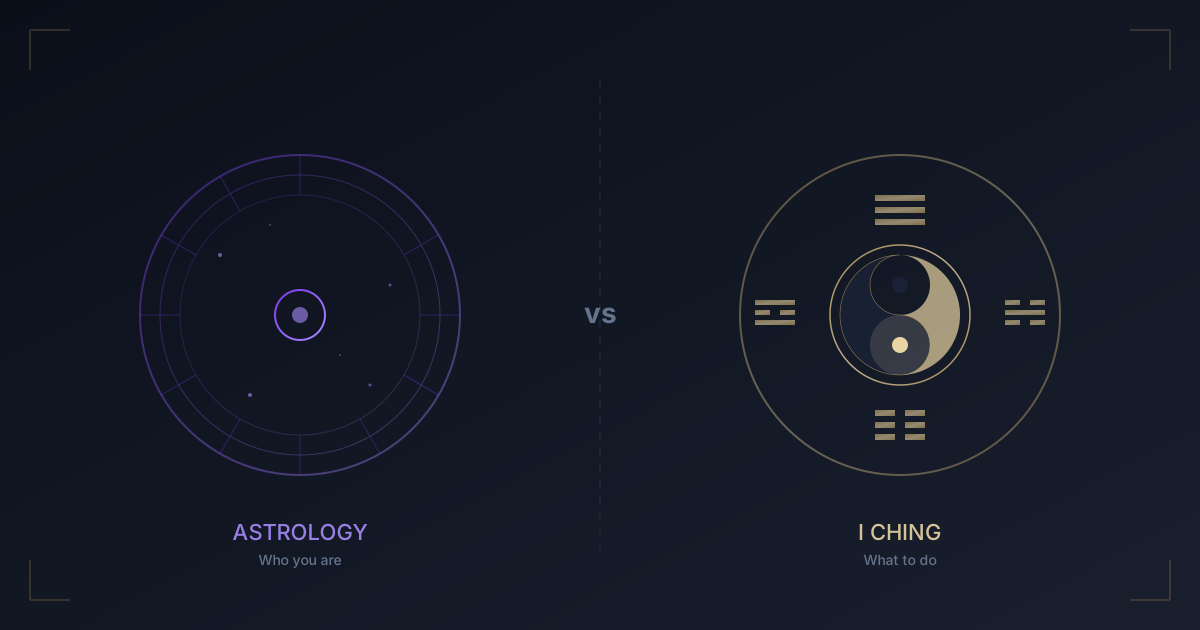
If you've ever wondered about I Ching vs astrology—which one to use, how they're different, or whether you even need to choose—you're asking the right question.
You check your horoscope. It says something like: "Venus enters your fifth house this week—romance is in the air. Stay open to new connections."
Nice. But you're not wondering about romance in general. You're wondering whether to text your ex back tonight. Or whether to take that job offer that arrived this morning. Or how to handle the coworker who just threw you under the bus in a meeting.
Astrology tells you about the cosmic weather. The I Ching tells you what to do.
That's the core difference—and it's why millions of people who love astrology are discovering that the I Ching fills a gap they didn't know they had.
The Fundamental Split: Identity vs. Decision
Astrology and the I Ching both belong to the world of "guidance systems"—tools humans have used for millennia to navigate uncertainty. But they answer fundamentally different questions.
Astrology answers: Who am I?
Your birth chart is fixed the moment you're born. The position of the planets at that exact time and place creates a cosmic fingerprint that never changes. Astrology helps you understand your nature—your tendencies, strengths, blind spots, and compatibility with others.
The I Ching answers: What should I do?
The I Ching doesn't care when you were born. It cares about this moment—the specific situation you're facing right now, with all its complexity and uncertainty.
When you consult the I Ching, you bring a real question. The oracle responds with guidance tailored to that exact situation: whether to advance or retreat, push hard or stabilize, act now or wait for better timing.
This is decision support. Not "who you are," but "what to do next."
The Problem with Horoscopes (That Nobody Talks About)
Let's be honest: most people who read their horoscope aren't doing deep chart work. They're checking their daily or weekly horoscope for guidance on what's happening now.
And here's the problem: daily horoscopes are written for everyone born under that sign. That's roughly 600 million people per sign. The guidance has to be generic enough to apply to all of them.
"This week favors communication. Speak your truth."
Okay, but how? Should I be direct or diplomatic? Should I speak first or listen? Is this a moment to push my agenda or to receive feedback?
The horoscope can't tell you, because it doesn't know your situation. It only knows your birth chart.
The I Ching works the opposite way. It doesn't know (or care) about your birth chart. But it responds to the specific question you're asking, at the specific moment you're asking it.
Same person, same day, two different questions = two different readings. That's the difference between weather forecasting and navigation. Astrology tells you the conditions. The I Ching tells you how to move through them.
What the I Ching Actually Does
The I Ching (pronounced "ee ching") is a 3,000-year-old Chinese text—older than the Bible, older than most of recorded history. Carl Jung wrote the foreword to its most famous English translation and developed the concept of "synchronicity" to explain how it works.
At its core, the I Ching contains 64 hexagrams—archetypal patterns that represent different situations and dynamics in human life. When you consult it, you generate a hexagram through a chance-based method, then receive guidance for that specific pattern.
But here's what makes the I Ching radically different from astrology: it's prescriptive, not just descriptive.
A horoscope describes the energy around you. The I Ching tells you:
- Whether to push forward or hold your position or retreat
- What action to take in specific terms
- What shadow patterns to watch for—how you might misuse the advice
That last part is crucial. Good guidance isn't just "do this." It's also "watch out for this tendency that will sabotage you."
Five Dimensions of Real Decisions
Here's where modern I Ching apps have evolved far beyond traditional interpretations.
When you're facing a decision, you're usually not asking a vague "what should I do with my life?" You're asking something specific:
- Career: Should I push for this promotion? Take this meeting? Confront my boss?
- Love: Should I reach out? Pull back? Have the difficult conversation?
- Conflict: How do I handle this person who's making my life difficult?
- Energy: Am I pushing too hard? Not hard enough? How should I manage my resources today?
- Timing: Is now the right moment to act, or should I wait?
Traditional I Ching texts give one general reading. Modern approaches recognize that the same hexagram might mean "push hard" in your career but "hold steady" in your relationship.
The Shadow: What Astrology Doesn't Warn You About
One of the most powerful concepts in Jungian psychology is the "shadow"—the parts of ourselves we don't want to see. Our blind spots. The ways we sabotage ourselves while thinking we're doing the right thing.
Astrology acknowledges shadow material in theory (the challenging aspects, the difficult transits), but daily horoscopes rarely go there. They're usually optimistic, aspirational, or at worst vaguely cautionary: "Watch out for miscommunication."
The I Ching, especially in its modern implementations, builds shadow warnings directly into every reading.
Let's say you receive guidance to "lead with precision" in a career situation. The I Ching doesn't just tell you that. It also warns:
"Warning: Overreach. Power without restraint becomes sabotage."
Or in a love context, you might receive: "Initiate once. State intent cleanly. Then stop transmitting and observe response." Followed by:
"Warning: Dominance impulse. Do not turn affection into conquest."
This is the difference between advice and wisdom. Advice tells you what to do. Wisdom also tells you how you're likely to screw it up.
Real Examples: What I Ching Guidance Actually Looks Like
Let me show you what modern I Ching guidance looks like in practice—because it's very different from "Venus is in your fifth house."
Scenario: You're considering pushing for a promotion
An astrology reading might say: "Mars energizes your career sector this month. Ambition is favored."
An I Ching reading (let's say you draw Hexagram 1, "The Creative") might say:
Career stance: "SPEARHEAD EXECUTION"
Order: "Pick one objective. Issue clear directives. Ship the smallest decisive win today."
Shadow warning: "Overreach. Power without restraint becomes sabotage."
Action type: PUSH
See the difference? The I Ching gives you a specific action ("ship the smallest decisive win"), a tactical approach ("pick one objective"), and warns you exactly how you'll mess it up ("power without restraint becomes sabotage").
Scenario: You're unsure whether to text someone you're interested in
Astrology might say: "With Venus trine your Moon, emotional connections are highlighted. Trust your instincts."
The I Ching (let's say Hexagram 31, "Influence") might say:
Love stance: "ATTRACTION MODE"
Order: "Be present. Signal interest once. Let silence do work."
Shadow warning: "Chasing validation. Desire turns ugly when it begs."
Action type: PUSH
Again—specific action ("signal interest once"), specific strategy ("let silence do work"), specific warning about the trap ("desire turns ugly when it begs").
Scenario: Someone at work is causing problems
Astrology might say: "Mercury square Mars could trigger conflicts. Choose your words carefully."
The I Ching (let's say Hexagram 6, "Conflict") might say:
Conflict stance: "PAPER TRAIL MODE"
Order: "State facts. Log decisions. Keep communications short and archivable."
Shadow warning: "Rage typing. You will incriminate yourself."
Action type: STABILIZE
This is the level of tactical clarity the I Ching provides. Not "conflicts are possible"—but "keep communications short and archivable" and "you will incriminate yourself if you rage type."
Want This Level of Guidance?
Shadow OS gives you tactical I Ching readings across five dimensions—Career, Love, Conflict, Energy, and Timing—with shadow warnings built in.
Download on AndroidAction Types: Push, Stabilize, or Retreat?
Another dimension that the I Ching provides—and astrology doesn't—is a clear signal on the type of action required.
Not every situation calls for the same energy. Sometimes you need to:
- Push — Move forward assertively. Take initiative. Act decisively.
- Stabilize — Hold your current position. Don't advance, don't retreat. Maintain what you have.
- Retreat — Pull back strategically. Conserve resources. Wait for better conditions.
Most horoscopes don't give you this kind of tactical clarity. They might say "be bold" or "be patient," but rarely do they distinguish between "hold steady" and "actively withdraw."
The I Ching makes this explicit. When you receive a reading, you know immediately whether this is a moment for action, maintenance, or strategic retreat.
That's actionable intelligence. Not vibes—vectors.
Why Not Both?
Here's the honest answer: you don't have to choose.
Many people use astrology for self-understanding and the I Ching for decision-making. They're not competing systems—they're answering different questions.
Use astrology when you want to understand:
- Your personality patterns and tendencies
- Compatibility dynamics with others
- Long-term cycles and themes in your life
- Why you react to certain situations the way you do
Use the I Ching when you need to decide:
- Whether to act now or wait
- How to approach a specific conversation
- What strategy to use in a conflict
- Whether to push forward or pull back
Think of astrology as your character sheet. The I Ching is your move.
The Real Question: What Do You Need Right Now?
If you're reading this, you've probably experienced the gap between "knowing yourself" and "knowing what to do."
You know you're a sensitive person. But should you express that sensitivity in this conversation, or protect it?
You know you're ambitious. But should you push for this opportunity, or is it a trap?
You know Mercury is in retrograde. But you still have to decide whether to sign the contract, send the email, or book the flight.
Astrology gives you the map of who you are. The I Ching gives you turn-by-turn directions for where you are right now.
Try It Yourself
The best way to understand the difference is to experience it.
Think of a real decision you're facing—not a hypothetical, but something that actually matters to you right now. Something in your career, your relationships, a conflict you're navigating, or a question of timing.
Then consult the I Ching with that specific question in mind.
Notice how different the experience is from reading a horoscope. The horoscope is about you in general. The I Ching is about this situation in particular.
One Clear Move. Every Day.
Shadow OS gives you a directive (Lean In, Hold Steady, or Step Back), the inner resistance most likely to sabotage you, and one small step you can take today.
Download on Android