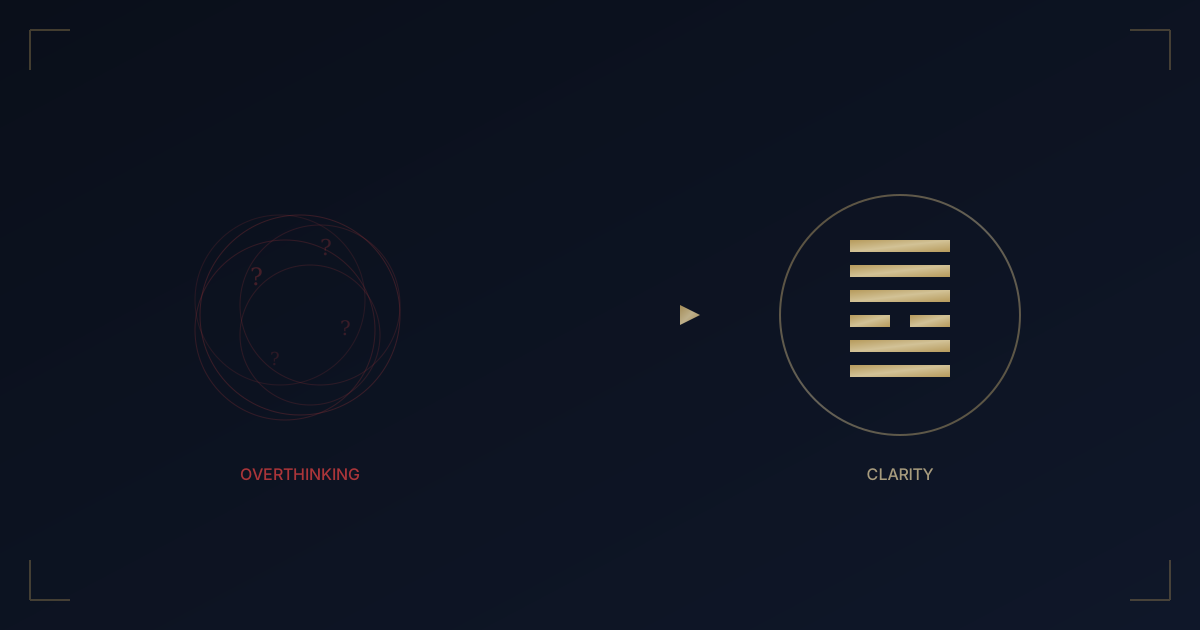
It's 11pm. You're lying in bed, staring at the ceiling, running the same decision through your head for the fourteenth time today.
Should you take the job? Leave the relationship? Have the conversation? Send the email?
You've made lists. You've talked to friends. You've Googled "how to make hard decisions" and read articles about weighted decision matrices and Eisenhower boxes. Nothing has helped.
The problem isn't that you lack information. The problem is that you can't stop thinking.
Welcome to decision fatigue—and if you're reading this, you're probably trapped in it right now.
What Decision Fatigue Actually Is
Decision fatigue isn't just "being tired of deciding things." It's a specific cognitive state where your brain's decision-making capacity has been depleted, but you keep trying to use it anyway.
Research by social psychologist Roy Baumeister found that making decisions uses the same mental resource as self-control. Every choice you make—what to eat for breakfast, how to word an email, whether to speak up in a meeting—draws from a finite daily reservoir.
When that reservoir empties, one of two things happens:
Decision avoidance: You simply stop deciding. You put off the hard choice, maintain the status quo, and tell yourself you'll figure it out "when you have more clarity."
Decision loops: You keep thinking about the decision without resolving it. You circle the same considerations endlessly. You know all the pros and cons by heart. You've mentally rehearsed every possible outcome. But you can't actually choose.
Both states feel like thinking. Neither is productive.
Why "Just Decide" Doesn't Work
The obvious advice for decision fatigue is to just make a choice and move on. "Any decision is better than no decision." "Done is better than perfect." "Trust your gut."
This advice isn't wrong, but it misses something crucial: when you're in decision fatigue, your gut is silent.
The overthinking mind has disconnected from the body's wisdom. You're stuck in analysis, which is exactly the faculty that's depleted. Telling someone in decision paralysis to "just decide" is like telling someone who's lost to "just know where you are."
What you need isn't more thinking. It's a different kind of thinking—one that bypasses the exhausted analytical mind and accesses the part of you that already knows what to do.
Enter: The I Ching
Here's where an unexpected tool comes in.
The I Ching (pronounced "ee ching") is a 3,000-year-old Chinese text that Carl Jung called "an oracle that examines the unconscious." It's been used continuously for longer than almost any other book in human history—not because people are superstitious, but because it works.
And what it specifically works for is decision-making under uncertainty.
The I Ching doesn't give you more information to analyze. It doesn't add to your mental load. Instead, it does something different:
It forces you to formulate your question clearly. Often, the reason you can't decide is that you're not actually clear on what you're deciding. The I Ching won't work with vague anxiety—it requires a specific question. This alone is clarifying.
It provides a structured response that short-circuits loops. Instead of endlessly weighing pros and cons, you receive a specific answer: push forward, hold position, or pull back. The exhausted analytical mind can stop.
It includes warnings about how you'll sabotage yourself. The I Ching doesn't just tell you what to do—it tells you how your own psychology will undermine the advice. This speaks to the blind spots that analysis can't see.
It gives you permission to stop thinking. Once you've consulted, you have an answer. You may or may not follow it, but the loop has an exit.
How It Works (Without the Mysticism)
You don't need to believe in anything supernatural to use the I Ching effectively.
Here's the practical mechanics:
The I Ching contains 64 hexagrams—archetypal patterns that map to different situations in human life. When you consult it, you generate a hexagram through a chance-based process (traditionally coins, now often apps). Then you receive guidance for that specific pattern.
Think of it like this: your overthinking mind has been running the same analysis in the same way for days. The I Ching introduces randomness that breaks the loop, then provides a framework for interpreting that break.
Even if you believe the process is "just random," the interpretation still forces you to see your situation from a different angle. And that new angle is often enough to unlock a decision that was stuck.
Carl Jung believed something more was happening—he called it "synchronicity," a meaningful coincidence between the random result and your actual situation. But you don't need to believe in synchronicity to benefit from the process. The structured reflection alone is valuable.
The Five Dimensions of Decision
Modern I Ching practice has evolved beyond the traditional single-answer format.
When you're stuck on a decision, you're usually stuck in a specific dimension:
Career: The decision relates to work, money, professional reputation, or advancement. You're wondering whether to push for something, hold your position, or strategically retreat.
Love: The decision involves a relationship—romantic, family, or close friendship. You're wondering whether to reach out, create space, or have a difficult conversation.
Conflict: You're dealing with someone who's making your life difficult. You're wondering how to handle them—confront, document, disengage, or something else.
Energy: The decision is really about resource management. You're wondering if you're pushing too hard, not hard enough, or whether you need recovery before you can even think clearly.
Timing: You know what you want to do, but you're not sure if now is the right moment. You're wondering whether to act immediately, wait for a better window, or accept that the window has closed.
By identifying which dimension your decision lives in, you get much more targeted guidance than a generic "here's what to do."
What I Ching Guidance Actually Looks Like
Let's make this concrete.
Say you're stuck on whether to ask for a raise. You've been going back and forth for weeks. You've Googled salary data. You've rehearsed conversations in your head. You're still stuck.
You consult the I Ching with the question: "How should I approach asking for a raise?"
You select the Career dimension.
You receive Hexagram 11, "Peace" — with the theme: "Flow is favorable; expand with control."
The specific guidance:
Stance: EXPANSION PUSH
Order: "Schedule the meeting. Ship the deliverable. Ask for the upgrade."
Action type: PUSH
Shadow warning: "Complacency. Ease can make you sloppy."
The reading is telling you to move forward—this is a green light for asking. But it's also warning you: don't get so comfortable with the favorable conditions that you half-ass the execution. Prepare properly, then ask.
Now compare that to being stuck in your head: "Should I ask? What if they say no? What if it's not the right time? Maybe I should wait until after the next project..."
The I Ching cuts through the loop. Push. Do it. But do it well.
The Shadow: Why This Works for Overthinkers
Here's the part that's specifically designed for people who overthink: the shadow warning.
Every I Ching guidance comes with a warning about how you're likely to sabotage yourself. This isn't generic caution—it's pattern-specific.
If you're told to push forward: The shadow might be "Overreach. Power without restraint becomes sabotage." (You'll push too hard and damage relationships.)
If you're told to wait: The shadow might be "Anxiety loop. Motion is not progress." (You'll confuse busy-ness with productive waiting.)
If you're told to retreat: The shadow might be "Pride. Staying to prove a point is how you lose." (You'll refuse to strategically withdraw because your ego won't let you.)
Overthinkers don't just struggle to decide—they struggle to trust their decisions. The shadow warning addresses this by naming exactly how your decision might go wrong. Once you've seen the trap, you can avoid it.
Adding This to Your Mental Toolkit
Think of the I Ching as another tool alongside journaling, meditation, and talking to trusted friends. Each has its use case:
Journaling helps you process emotions and track patterns over time.
Meditation helps you calm the nervous system and access present-moment awareness.
Talking to friends gives you outside perspectives and reality-checks your blind spots.
The I Ching helps you break decision loops and get actionable guidance when analysis has failed.
These tools complement each other. You might journal about a decision, realize you're stuck, consult the I Ching, get a direction, and then meditate to calm the anxiety around executing.
Breaking the Loop Tonight
If you're lying in bed running a decision through your head, here's what to do:
- Stop trying to analyze. Your analytical faculty is depleted. More thinking won't help.
- Get the decision out of your head. Write it down as a specific question. Not "what should I do about my job" but "should I accept the offer from Company X?"
- Identify the dimension. Is this a Career decision? Love? Conflict? Energy? Timing?
- Consult. Use the I Ching to get a direction: push, stabilize, or retreat. Read the shadow warning.
- Accept the answer temporarily. You don't have to commit forever. But for tonight, you have a direction. The loop can stop. You can sleep.
- Revisit in the morning. Does the guidance still resonate? If yes, act. If no, you've at least broken the pattern enough to think fresh.
The Tracking Layer
Here's what makes this different from one-off "oracle consultations":
Modern I Ching apps let you track your decisions over time. After receiving guidance, you can log whether you executed the advice, adjusted based on circumstances, or failed to follow through.
Over weeks and months, patterns emerge. You start seeing which types of guidance you consistently ignore, which shadow warnings accurately predicted your mistakes, and whether you tend to "push" when you should "stabilize."
This transforms the I Ching from mystical consultation into empirical self-study. You're not just getting advice—you're building a map of your own decision-making tendencies.
Why This Works (The Psychology)
Even if you're skeptical about ancient Chinese oracles, here's what's happening psychologically:
Externalization: Getting the decision out of your head and into a structured format reduces cognitive load.
Random disruption: The chance-based hexagram generation breaks the repetitive thought loop and forces new angles.
Archetypal framing: The hexagram patterns provide interpretive frameworks that your exhausted mind couldn't generate on its own.
Permission structure: Having "consulted an oracle" gives you psychological permission to stop deliberating and act.
Shadow integration: The warnings about self-sabotage speak to unconscious material that conscious analysis misses.
You don't need to believe the I Ching is supernatural to benefit from these mechanisms. The process works regardless of your metaphysics.
Break the Loop Tonight
Shadow OS gives you I Ching guidance across five dimensions—Career, Love, Conflict, Energy, and Timing—with shadow warnings that name exactly how you'll sabotage yourself.
Download on AndroidStart Tonight
If you've read this far, you're probably stuck on something.
Here's my challenge: before you close this page, write down the decision you've been circling. Make it a specific question. Then consult the I Ching—with coins if you know how, or with an app like Shadow OS if you want the easiest path.
Get an answer. Sit with it. Then—and this is the important part—stop thinking about the decision for the rest of the night.
Tomorrow, you can decide whether to follow the guidance. But tonight, the loop is over.
You've been carrying this long enough.